
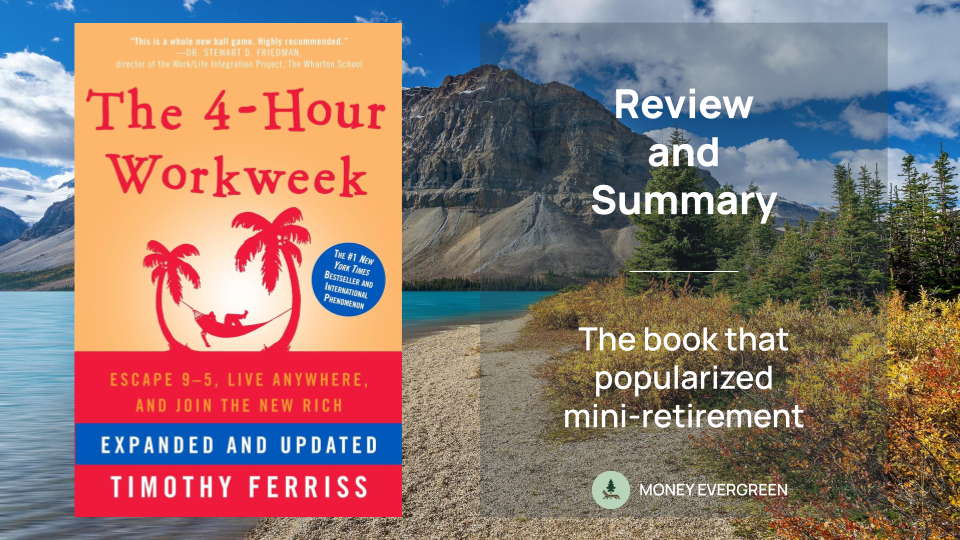
The 4 hour work week mini-retirement book and concept have become increasingly mainstream for corporate professionals searching for ways to enjoy chunks of retirement throughout their life instead of waiting until 60-something.
That’s exactly the lifestyle redesign proposed in The 4-Hour Workweek by Tim Ferriss, the best-selling book first published in 2007. He coined and popularized the concept of mini-retirement — taking extended breaks from work to travel, learn, and recharge without waiting for traditional retirement.
At 32 years old, I took my own year-long mini-retirement from my stressful 9–5 corporate career, and I’d do it again.
In this review, I’ll break down the Tim Ferriss mini-retirement framework, what works and what doesn’t, who the book is right for, and why it’s worth reading.
〉If you’d rather dive right into this mini-retirement book, you can get it here on Amazon or listen free with an Audible trial.
Quick Review: The 4-Hour Workweek
Rating:
(4.3/5)
Best for: Entrepreneurs, remote workers, digital nomads, career changers, FIRE movement members, anyone dreaming of more freedom
Pros:
+ Inspiring framework
+ Actionable mini-retirement blueprint
+ Practical exercises
+ Life-changing mindset shift
Cons:
– Some tactics feel dated
– Understates true cost
– Not all advice applies universally
Price: $10–$16 (or free with Audible trial)
Tim Ferriss’ 4 Hour Work Week Mini-Retirement Concept
Traditional Retirement vs. Mini-Retirement: Why Wait Until 65?
The core concept of the 4 hour work week mini-retirement book is about designing your best life. Ferriss challenges the traditional retirement model with a simple question: Why save the best years of your life for when you’re least able to enjoy them?
Traditional retirement follows this path:
- Work 40+ years in jobs you tolerate
- Save money for “someday”
- Retire at 65 when your energy and health decline
Mini-retirement flips this script. Instead of one long retirement, you take multiple shorter breaks throughout your prime years while maintaining income.
How Ferriss Defines Mini-Retirement in the Book
The Tim Ferriss mini-retirement definition is: “relocating to one place for one to six months before going to another or returning home.” He emphasizes this isn’t vacation—it’s temporary relocation where you maintain productivity while experiencing different cultures and lifestyles.
The key distinction: vacations are about recovery from work you hate. Mini-retirements are about living fully while doing work you’ve designed around your life.
Why The Concept of Mini-Retirement Resonated
The concept of mini-retirement resonated with so many readers who felt trapped between the 9–5 hustle culture and lifestyle inflation. In The 4-Hour Workweek, Ferriss argues that deferring all leisure until retirement in old age is risky — health, energy, and time aren’t guaranteed. Readers agreed and needed a solution.
Ferriss proposed a real way for people to balance work-life freedom, detailing key points like building income streams and flexibility that make mini-retirements possible.
My own comprehensive mini-retirement guide outlines all the aspects of career breaks you need to know as this concept has evolved over the years.
Key Lessons on Mini-Retirement from The 4-Hour Workweek
1. Redefining Retirement
Retirement isn’t an age — it’s a lifestyle. Instead of working toward “someday,” Ferriss urges readers to incorporate freedom into life now. Through lifestyle design, you can prioritize personal values—whether it’s travel, family, or creative projects—over rigid career paths.
2. Escaping the 9–5 Deferred Life Plan
The biggest trap is postponing happiness. A mini-retirement is a way of saying, “I won’t wait decades to enjoy my life.” Ferriss challenges the notion that success equals long office hours. Instead, he advocates measuring productivity by results, not time spent.
3. Automating Income for Time Freedom
Ferriss suggests building businesses, investments, or systems that generate passive or semi-passive income. This creates financial flexibility to step away from traditional work.
4. Planning and Executing a Mini-Retirement
From choosing a travel destination to setting a job exit/return strategy, Ferriss outlines how to make an extended break realistic.
〉Get the full playbook in Tim Ferriss’ book → The 4-Hour Workweek.
Tim Ferriss’s Mini-Retirement Framework
Tim Ferriss DEAL Framework Breakdown (Definition, Elimination, Automation, Liberation)
Ferriss structures the entire book around DEAL—four steps that lead to mini-retirement freedom:
Definition (D): Clarify what you want and calculate the real cost of your dreams. Most people overestimate what mini-retirement costs.
Elimination (E): Cut non-essential tasks using the 80/20 rule. He shows how 20% of your activities produce 80% of your results.
Automation (A): Build systems and hire virtual assistants to handle routine tasks. This step transforms you from employee to owner of your time.
Liberation (L): Break location dependence and create mobility. This final step enables the geographic freedom essential for mini-retirement.
Ferriss’ Step-by-Step Mini-Retirement Planning Process
The book provides a concrete planning framework for travel-centric mini-retirements:
- Calculate your Target Monthly Nut (TMN): Your absolute minimum monthly expenses
- Choose your location based on cost arbitrage: Countries where your TMN creates comfortable living
- Build location-independent income: Revenue streams that don’t require your physical presence
- Test with mini-trips: Start with 1-2 week trips before committing to months
The “Dreamlining” Exercise for Planning Your Mini-Retirement
Dreamlining is Ferriss’ goal-setting methodology specifically designed for mini-retirement planning:
- List 5 things you want to have, be, and do
- Calculate the real monthly cost for each
- Determine the monthly income required
- Create specific timelines for achieving each goal
37 Specific Mini-Retirement Strategies
The author doesn’t just theorize—he provides numerous concrete tactics such as:
- How to negotiate remote work arrangements (even in traditional companies)
- Specific countries where $1,000/month creates a middle-class lifestyle
- Virtual assistant hiring and management systems
- Email templates for reducing communication by 80%
- The “information diet” that eliminates time-wasting news consumption
- Geographic arbitrage formulas for maximizing purchasing power
Can You Really Work 4 Hours Per Week? (Ferriss’ Honest Reality)
What Ferriss Actually Means
The “4-hour workweek” title misleads people. Ferriss clarifies he doesn’t work exactly four hours weekly. Instead, he works efficiently in concentrated bursts, often 4-10 hours of focused work that produces the same results as others’ 40-hour weeks.
The real message: eliminate busy work and focus only on activities that directly advance your goals.
The Types of Businesses Ferriss Says This Works For
Ferriss is specific about which business models enable mini-retirement:
Works Best:
- Information products and courses
- Drop-shipping and e-commerce with automation
- Consulting with productized services
- Software as a Service (SaaS) with minimal maintenance
Doesn’t Work For:
- Traditional service businesses requiring your physical presence
- Retail businesses without automation systems
- Most traditional employment (though remote negotiation is possible)
Ferriss’ Own Mini-Retirement Experiences
Ferriss shares his personal mini-retirement experiences:
- Six months learning tango in Buenos Aires
- Language immersion programs in Japan
- Motorcycle racing training in Europe
He’s transparent about challenges: loneliness, relationship strain, and the difficulty of returning to “normal” life after extended freedom.
Who This Book is For (and Not For)
Ferriss’ Target Audience: Entrepreneurs and Knowledge Workers
He writes primarily for:
- Entrepreneurs who can systematize their businesses
- Knowledge workers with negotiable remote arrangements
- People earning $50,000+ who feel trapped by lifestyle inflation
- Anyone questioning the traditional career path
When This Book Won’t Help You
He’s honest about limitations:
- If you’re just starting your career and need skill development
- If you genuinely love your work and workplace culture
- If you have significant debt that prevents risk-taking
- If you prefer security over freedom and flexibility
Prerequisites Ferriss Assumes You Have
The book assumes you already possess:
- Basic financial literacy and emergency savings
- Marketable skills that create value for others
- Willingness to embrace uncertainty and discomfort
- Self-discipline to work without traditional structure
The 4-Hour Workweek Pros and Cons (After 18+ Years)
What Still Works Today (Despite Being Written in 2007)
The core principles remain incredibly relevant:
- Geographic arbitrage: Still powerful with remote work acceleration
- The 80/20 principle: More applicable than ever in our distraction-filled world
- Virtual assistance: Platforms like Upwork and Fiverr have made this easier
- Value-based pricing: Essential as the gig economy grows
What’s Outdated in Ferriss’ Approach
Some elements feel dated:
- Specific web tools: Many recommended platforms no longer exist, and newer AI automation tools weren’t yet created
- Cost estimates: Inflation has changed the economics of many recommended countries
- Social media impact: The book predates how social platforms changed business
- Mini-retirement duration: I would define a 1 to 6 month break as a micro-retirement (newer term), but the concept is the same regardless of naming convention
What The 4-Hour Workweek Doesn’t Cover About Mini-Retirement
Notable gaps in the book:
- Relationship impact: How extended travel affects marriages and friendships
- Health considerations: Managing healthcare across countries
- The true financial cost: Lost income and benefits plus foregone investment returns creates a high opportunity cost (use my mini-retirement calculator to get your real number)
- Reentry challenges: Returning to “normal” life and career after extended freedom
Key Takeaways from The 4-Hour Workweek Mini-Retirement Chapters
The “Geographic Arbitrage” Strategy
Ferriss demonstrates how location choice multiplies your purchasing power. He shows specific examples:
- $3,000/month in Manhattan = survival mode
- $3,000/month in Prague = upper-middle class lifestyle
- $3,000/month in Thailand = luxury living
This isn’t about finding the cheapest places—it’s about finding locations where your money creates the lifestyle you want.
His “Minimum Effective Dose” Philosophy
Ferriss applies the minimum effective dose concept from fitness to work and lifestyle design. Just as you need the smallest amount of exercise to trigger adaptation, you need the minimum amount of work to create maximum results.
This philosophy transformed how I approach projects. Instead of perfecting everything to 100%, I aim for 80% completion and move on to the next opportunity.
Why Ferriss Says Mini-Retirement Beats Traditional Retirement
He argues mini-retirement is superior because:
- Energy alignment: You have maximum energy during your prime years
- Reduced risk: Multiple income streams provide security
- Skill development: Each mini-retirement teaches new capabilities
- Relationship benefits: Shared adventures strengthen bonds with partners
〉Read all of Tim Ferriss’ mini-retirement strategies and advice → The 4-Hour Workweek.
Frequently Asked Questions (FAQs)
Yes, though some of the book’s online business tactics feel dated, the core concepts of lifestyle design and career breaks are timeless.
Not overnight — but with planning (remote work, savings, automation), many people can.
Mini-retirement doesn’t require going abroad or travel at all. You can take extended time off locally, explore hobbies, or pursue an entrepreneurial venture. A mini-retirement can, and should, be anything you want it to be.
It’s more about mindset shifts than exact “how-to” formulas. The value is in rethinking what’s possible.
Get the paperback if you want to start planning a career break so you can utilize the exercises and worksheets included in the physical copy. Download the digital version if you prefer highlighting and note-taking on Kindle. Listen to the audiobook if you’re more interested in hearing the philosophies, stories, and examples for lifestyle design inspiration.
Final Verdict: Is The 4-Hour Workweek Worth Reading?
The 4-Hour Workweek remains the ultimate mini-retirement book and one of the most influential lifestyle design guides. If you’ve ever dreamed of pressing pause on your career to actually live life, Tim Ferriss’ mini-retirement book provides both the motivation and framework to get started.
I’m personally still on my own mini-retirement, and simply recollecting the specifics from the book to write this review is inspiring me to start planning my next break already.
The 4 hour work week mini-retirement philosophy alone makes it worth reading, even if you adapt the tactics to your personalized version of work-life freedom. After all, the goal is to live life on your own terms.

The 4-Hour Workweek: Best Deals and Formats
- Paperback ($16.00) — Best for those planning a mini-retirement to utilize worksheets.
- Digital ($9.99) — Perfect if you prefer highlighting and note-taking on Kindle.
- Audiobook (Free Trial) — Listen for inspirational concepts and try Audible for free.


